

Tucked away in the South Transept of St Stephen’s you’ll find a memorial to one of the greatest poets of the twentieth century, Thomas Stearns Eliot who served as Churchwarden here for twenty-five years, and who was a faithful member of the congregation for over forty.
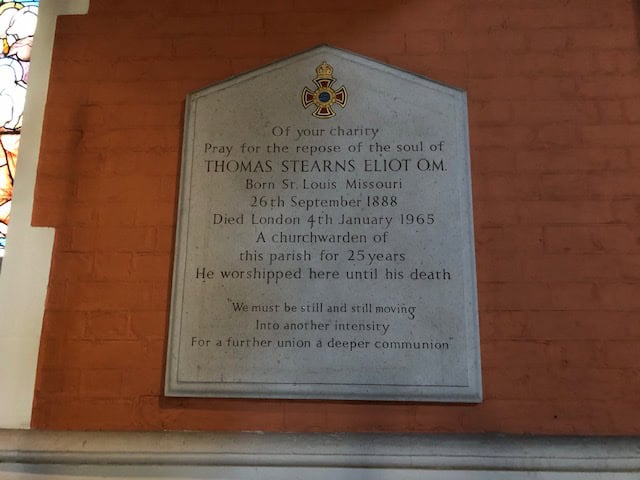
Born in St Louis, Missouri, USA on 26 September, 1888, Thomas Sterns Eliot moved to the United Kingdom in 1914, initially to study at Merton College, Oxford. By 1927 he felt sufficiently at home here to become a British subject. In the same year, abandoning his American Unitarian roots, he was baptised and confirmed in two separate, private ceremonies into the Church of England. He later described himself as “Classicist in literature, royalist in politics and anglo-catholic (sic) in religion”. (Preface to “For Lancelot Andrewes: Essays in Style and Order”). It was the discipline of that Anglo Catholic faith that first drew Eliot here, and which came to underpin not only his work but also his very identity.
Eliot’s association with St Stephen's was close, profound and immensely important. He lived nearby in South Kensington. Married to Vivienne Haigh-Wood in 1915, the marriage failed, plagued by Vivienne’s battle with mental health and they formally separated in 1933. Vivienne was then committed to a mental hospital where she died in 1947. In 1957 Eliot married Valerie Fletcher in a private ceremony. Valerie’s funeral was held at St Stephen’s following her death on 9 November, 2012.
Following his traumatic separation from Vivienne, Eliot found refuge and solace living in the Presbytery for the clergy of St Stephen’s, Gloucester Road, then at 9, Grenville Place around the corner from the church. He was conscientious in his pursuit of the Christian Faith through the doctrines, disciplines, and worship of the Anglo Catholic world; he was a regular communicant at Mass here at St Stephen’s and was deeply affected by the powerful ritual of sacramental worship still be found in the worship of this church. He made his sacramental confession regularly, where he found the enormous comfort and assurance of forgiveness and restoration that had previously been all too elusive in his life.
He attended silent retreats at Anglican monasteries, going to the monks of the Society of the Sacred Mission, then at Kelham, for the first time in 1933. Trips also to the Anglican Benedictines at Nashdom followed, and he had correspondence with the monks at the Community of the Resurrection at Mirfield in Yorkshire, which flourishes to this day.
It is significant too that the title of the last poem in Four Quartets, Little Gidding, is taken from the location of a lay religious order that thrived in that village in Huntingdonshire in the 17th century - an attempt at a rediscovery of the power and rhythm of the monastic life lost at the Reformation of the 16th century, and not really recovered until a revival of Anglican religious orders as a fruit of the Oxford Movement in the 19th century.
In these monastic visits, as in his regular visits to the oasis-like churches in the City of London, Eliot experienced powerfully and appreciated deeply that “still point of the turning world” of which he speaks in his poem Burnt Norton. So here too, in this church of St Stephen, where Eliot himself, as the senior layman, shepherded this congregation and where he treasured and nurtured this “still point “ in the hustle and bustle of modern- day, cosmopolitan London and which we, his successors here in the Faith, still treasure and humbly offer to this day. Here still also that place where Time and Eternity meet in the ongoing worship, life and fellowship of this 21st century “anglo-catholic” (sic) community, where
“Time past and time future point to one end, which is always present”
Burnt Norton, Four Quartets